"The biggest mistake Indian casino users make is assuming a betting system will change the mathematical odds of the wheel. A bonus is only useful when the terms are clear, and a strategy is only valid if it serves as a stop-loss tool. Treat casino play as entertainment, not income. Before you deposit, check the withdrawal rules and understand the true cost of the game." - Nisha Rao, Casino and Betting India

Roulette Online Guide: Rules, Demo Play, Live Dealer and Real Money
RTP
97.30%
Volatility
Low
Max win
35:1

Online gambling carries inherent financial risks. This guide explains the mechanics of the game, clarifies the mathematical reality of payouts, and provides practical checks for finding a secure gaming environment. Play responsibly and within your pre-set limits.
Quick summary: Roulette is a negative-expectation casino game in every variant. European roulette gives a 2.70% house edge, American 5.26%, and French (with La Partage) as low as 1.35% on even-money bets. No betting system changes those numbers. Demo mode lets you learn layout, pace and bet types risk-free. Live dealer adds social immersion but slows your hourly exposure. Before depositing real money in India, verify the platform's licence, payment options (UPI/INR) and bonus wagering terms.

What is roulette and how does the game work
Roulette is a casino game where you try to predict the final resting pocket of a small ball on a spinning wheel. The basic mechanical sequence relies on three components: the roulette wheel, the ball, and the roulette table. You place bets on the table, the dealer spins the wheel, and the outcome is determined entirely by chance.
Whether you play standard casino roulette or a digital roulette game, the physical laws of the wheel or the verified Random Number Generator (RNG) algorithms dictate the outcome. Every spin is an independent event. Past results do not influence future outcomes. This is worth repeating because many players struggle to accept it.

"Each roulette spin is an independent trial; the probability of any single number landing remains unchanged regardless of previous results." - Evidence-Based Guide to Online Roulette (2026)
This structural simplicity is what makes playing roulette highly accessible, yet mathematically unforgiving for anyone who tries to beat the odds long-term.

The roulette wheel, table and betting flow
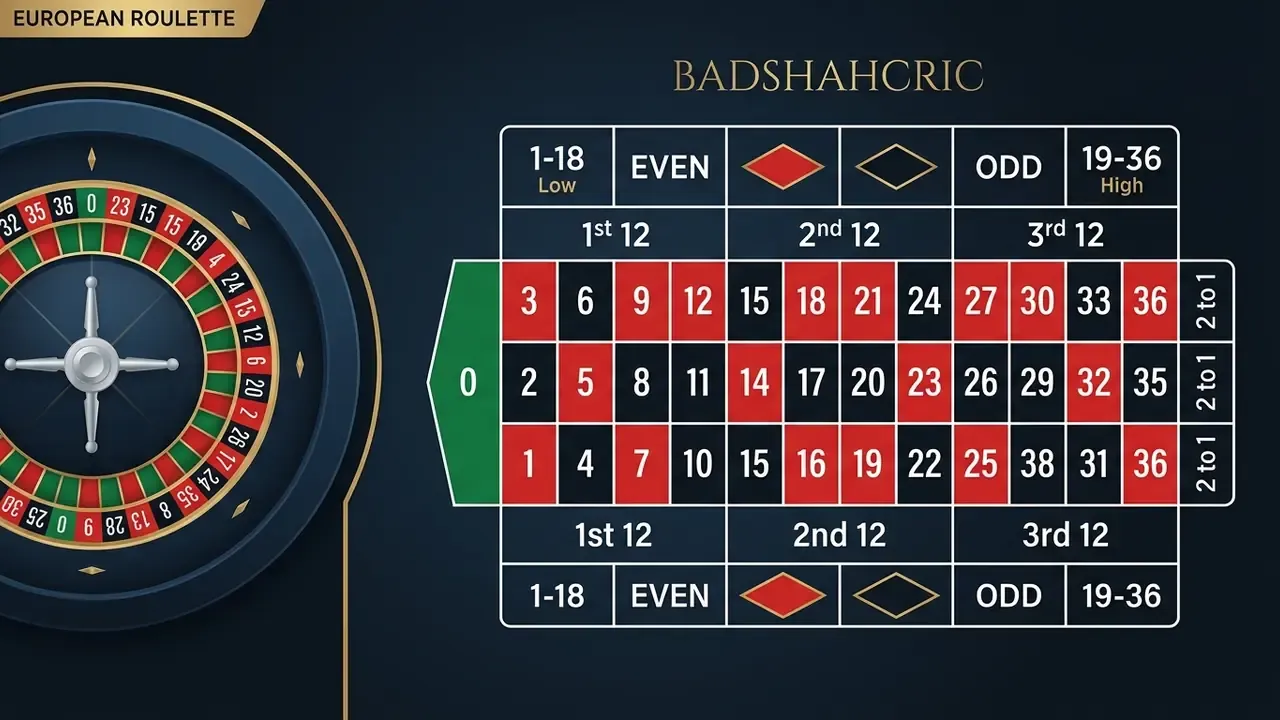
The roulette wheel features numbered pockets from 0 to 36 (and an additional 00 in some versions), while the roulette table acts as the designated grid where you arrange your chips. The betting flow follows a strict sequence:
- Select your chip value - pick a denomination on the interface.
- Place your bets - position chips on the target areas of the betting layout.
- Betting closes - the dealer announces "no more bets" or the software timer expires.
- Spin - the wheel turns and the ball is released.
- Result - the ball settles in one numbered pocket; wins and losses are resolved.
During digital play, you control the pace by selecting the chip value on your screen and tapping the target area before hitting the spin button. It feels intuitive after two or three rounds, honestly.

How a round ends and how players win
A round ends the exact moment the dropped ball settles into a single numbered pocket on the roulette wheel. Players win if their placed bets cover that specific number, colour, or category. A straight bet on a single number pays 35:1, although the true odds on a European wheel are 36:1. That one-pocket gap is precisely what creates the casino's 2.70% house edge.
A combined bet on red or black pays only 1:1 because it covers 18 of 37 pockets. Much higher probability, much smaller reward. Once the wins and losses are calculated and settled by the dealer or software, the table clears for the next round.

Roulette rules every beginner should know
The primary roulette rules dictate that your objective is to predict the correct outcome of the spin without exceeding table limits or betting after the time window closes. Before you actually start playing roulette, verify the minimum and maximum bets permitted at your chosen table.
Table limits constrain the amount you can wager on inside bets compared to outside bets. They serve both to protect the casino from high-risk progressive betting and to help players manage their session exposure. If you attempt to place a bet after the dealer or software announces the end of the betting phase, that placement will be rejected.
One small detail beginners often miss: the minimum bet for inside bets usually applies to the total of all your inside wagers, not each individual chip placement.

How to place bets on the table
- Straight up -chip in the centre of a single number square.
- Split -chip on the line between two adjacent numbers.
- Street -chip on the outer edge of a row of three numbers.
- Corner -chip on the intersection where four numbers meet (e.g., 25/26/28/29).
- Six line -chip on the junction of two adjacent rows.

For outside bets, you place chips on the clearly labelled perimeter zones: Red/Black, Odd/Even, High/Low, Dozens or Columns. The game interface relies on this exact placement to calculate your risk and eventual payout.
What happens after the spin
After the spin concludes and the ball rests, the winning number is formally registered by the game. In a live format, the dealer physically marks the number with a dolly. In an online roulette game, the software instantly highlights the winning selection. All losing bets are swept from the table, and the payouts for winning wagers are automatically credited to your balance before the betting window opens again.
Inside bets, outside bets and roulette payouts explained
Bets in roulette are split into two structural categories based on their risk and reward: inside bets target specific numbers with low odds but high payouts, while outside bets cover large groups of outcomes with higher odds but much lower payouts. Understanding this difference is essential for managing your bankroll.
Inside bets carry a high risk of depletion. Outside bets provide more regular, smaller wins. However, the casino's mathematical advantage remains identical across all standard bets on the same wheel. There is one exception worth flagging right away: the 5-number bet (0, 00, 1, 2, 3) in American roulette pushes the house edge to 7.89%. Avoid this bet entirely.

Inside bets on single numbers and small groups
Inside bets: exact coverage, payouts and European-wheel probability
| Bet Type | Numbers Covered | Example Placement | Payout | Win Probability (European) |
|---|---|---|---|---|
| Straight (Single) | 1 | 17 | 35:1 | 1/37 ≈ 2.70% |
| Split | 2 | 17/20 | 17:1 | 2/37 ≈ 5.41% |
| Street | 3 | 1/2/3 | 11:1 | 3/37 ≈ 8.11% |
| Corner (Square) | 4 | 25/26/28/29 | 8:1 | 4/37 ≈ 10.81% |
| Six Line | 6 | 1-6 | 5:1 | 6/37 ≈ 16.22% |
Inside bets are placed directly on the main grid of numbers, offering massive payout multiples if your specific number hits. A "straight" bet covers just one number and holds the highest payout at 35:1, but the chance of hitting it is only 1 in 37 on a standard European wheel. A "split" covers two numbers for 17:1, a "street" covers three for 11:1, a "corner" covers four for 8:1, and a "six line" covers six for 5:1.
These options appeal to high rollers because of the substantial immediate multipliers. But they create intense bankroll volatility due to long streaks of losses. If you place 37 straight bets of ₹100 each across 37 spins, statistically you would win once (₹3,500 back) and lose 36 times (₹3,600 out). That ₹100 gap is the house edge at work.

Outside bets for simpler roulette play
Outside bets: coverage, payouts and European-wheel probability
| Bet Type | Numbers Covered | Payout | Win Probability (European) |
|---|---|---|---|
| Red / Black | 18 | 1:1 | 18/37 ≈ 48.65% |
| Odd / Even | 18 | 1:1 | 18/37 ≈ 48.65% |
| High (19-36) / Low (1-18) | 18 | 1:1 | 18/37 ≈ 48.65% |
| Dozen (1-12 / 13-24 / 25-36) | 12 | 2:1 | 12/37 ≈ 32.43% |
| Column | 12 | 2:1 | 12/37 ≈ 32.43% |
Outside bets allow for broader roulette play, covering red or black, high or low, and odd or even numbers with payouts of 1:1. Betting on dozens or columns covers 12 variables and pays 2:1. Because you are covering nearly half the board, your spins result in much more frequent wins. This makes outside bets the core foundation for beginners looking to sustain their budget over a longer session.
Worth noting: even though outside bets feel "safer," the house edge remains 2.70% on a European wheel. You simply experience smaller swings, not better long-term odds.
Your chances depend not only on the type of bet but also on the type of wheel you choose, a distinction covered in the next section.
European, American and other roulette games
The main difference between the various roulette games lies in how many zeroes sit on the active wheel and what special rules apply. This directly controls the casino's house edge. As an informed player, you should prioritize variations that limit your mathematical expected loss.
European roulette vs American roulette
European roulette utilizes a wheel with 37 pockets, containing one single zero, resulting in a fixed house edge of 2.70% and a Return to Player (RTP) of 97.30%. On a European wheel your expected loss is approximately ₹27 for every ₹1,000 wagered.
American roulette features 38 pockets because it adds a double zero (00) to the board, which elevates the casino's edge to 5.26% (RTP 94.74%). That means your expected loss roughly doubles: about ₹53 per ₹1,000 staked compared to the European game.
"Betting standard units on an American table will essentially double your expected financial loss over the exact same period compared to a European game." - Evidence-Based Guide to Online Roulette (2026)
Critical warning: Avoid the 5-number bet (0, 00, 1, 2, 3) in American roulette. It carries a house edge of 7.89%, the worst payout ratio on the entire table. Always check the wheel layout before putting real money on the line.
French roulette uses the same 37-pocket, single-zero wheel as the European version but includes two player-friendly rules that further reduce the house edge on even-money bets:
- La Partage - if the ball lands on zero, you lose only half of your even-money bet instead of the full amount.
- En Prison - your even-money bet is "imprisoned" for the next spin when zero hits. Win the next spin and the bet is returned; lose and it is forfeited.
With these rules in effect, the house edge on red/black, odd/even and high/low bets drops to just 1.35%, giving French roulette an RTP of 98.65%. That is the best you will find on any standard roulette table.
Quick comparison: house edge and RTP across roulette variants

| Variant | Pockets | House Edge (standard bets) | RTP |
|---|---|---|---|
| European | 37 (single 0) | 2.70% | 97.30% |
| American | 38 (0 + 00) | 5.26% | 94.74% |
| French (even-money bets) | 37 (single 0) | 1.35% | 98.65% |
If you only remember one thing from this section: pick European or French over American. The numbers are not close.
Live, auto and less common roulette variations
The digital market provides different games falling outside the classic parameters. Auto roulette depends on a motorized mechanical wheel without a real croupier, significantly increasing the frequency of rounds. Multi-ball or multi-wheel formats allow you to participate in several outcomes at once.
Modern live studios also offer game-show formats like Lightning Roulette, where random lightning strikes add multipliers from 50x up to 500x to straight-up bets. Visually dramatic, yes. But these multipliers do not alter the overall return to player in a statistically meaningful way.
Be aware that complex game limits and accelerated mechanics often increase the speed at which your budget is exposed to the house margin. Faster rounds mean more total wagering per hour, which means faster losses on average.

"Slowing online roulette reduces total wagering by decreasing the number of spins, not by increasing bet size." - Evidence-Based Guide to Online Roulette (2026), speed-of-play experiment
Roulette demo and free roulette: why practice before real money
A roulette demo allows you to test the interface, learn the diverse betting rules, and evaluate the game pace without undertaking any actual financial risk. Before transitioning into roulette real money modes, testing free roulette gives you a clear representation of how betting limits operate. Simulated environments utilize identical RNG logic as paid games, so the odds you encounter inside the demo reflect the true casino mechanics.
[QUIZ: 5 checks before moving from demo to real money roulette. Logic: yes/no questions about limits, wheel type, bonus rules. Results lead to 3 readiness scenarios.] Purpose: Help players self-assess before risking real funds.

- Check 1:Does the demo match the real money wheel (European vs American vs French)?
- Check 2:Are you clear on the minimum and maximum bets?
- Check 3:Is the game pace comfortable for your budget?
- Check 4:Have you tested your bet placement speed and combined-bet mechanics?
- Check 5:Do you have a strict loss limit and session time-cap defined for real play?

If you answered "no" to even two of these, stay in demo mode a bit longer. There is no rush.
What you can learn in roulette demo mode
In roulette demo mode, you learn how to place bets accurately, understand the pace of the dealer or software, and verify how payouts function. This is the optimal arena to practice a specific strategy or familiarize yourself with complex cross-board chip placements. By taking the time to play roulette online in a free capacity, you adapt to the table dynamics without the pressure of live chips.
Something I have noticed reviewing player feedback: most beginners underestimate how quickly rounds pass in RNG mode. Demo play reveals that pace before your wallet does.
"Among social casino players the most common motives are entertainment and challenge; some use demo mode specifically to practise skills before real-money wagering." - Evidence-Based Guide to Online Roulette (2026), social-casino player survey
Demo roulette vs real money roulette
The mathematical mechanics between demo roulette and real money roulette are the same, but the psychological impact is completely different. When financial consequences are removed, emotional arousal is significantly lower.
"Lifetime engagement in simulated gambling is associated with real gambling and gambling harm, regardless of the order of initiation." - Evidence-Based Guide to Online Roulette (2026), simulated vs monetary gambling study
Once real money is added to the playing roulette session, players are more likely to exhibit "chasing" behaviours, altering their planned strategies in response to losses out of frustration. The practice holds value, but it does not guarantee your emotional control when real funds are diminishing. Knowing the rules and managing your reactions are two very different skills.
Roulette online, roulette casino and live dealer formats
Choosing between a standard roulette online simulation and a roulette live casino depends entirely on your preference for pace versus social immersion. RNG software dictates standard digital action, delivering instantaneous results. A roulette live dealer setup, on the other hand, streams a human croupier from a physical studio directly to your mobile or desktop, blending the convenience of digital wagers with actual casino equipment.
Format Matrix: Free, Live, RNG and Real Money Roulette
| Game Format | Cost / Risk | Pace of Play | Immersion | Primary Benefit |
|---|---|---|---|---|
| Free / Demo | Zero Risk | Fast (Player Controlled) | Low | Practice and rule familiarisation |
| Standard RNG | Varies (Real Money) | Very Fast | Low | Quick sessions on mobile |
| Live Dealer | Varies (Real Money) | Slow (Dealer Paced) | High | Social, transparent and interactive |
Each format fits a different objective. Demo is for strategy testing, RNG is for convenience, and live games are for classic engagement. Match your goal to the matrix above before you commit any funds.
Standard online roulette vs live casino roulette
Standard online gameplay gives you total authority over the speed of the game. There is no wait time between spins, and you dictate when the betting window expires. Live casino roulette follows the strict schedule set by the dealer.
While playing online allows for a rapid accumulation of bets, faster game variations result in higher hourly player losses because speed increases total wagering volume, not bet size. Slower live tables naturally throttle how quickly your bankroll is subjected to the game's edge.
Here is a practical example: during an audit of mobile engagement, a user reported their funds drained unusually fast on an RNG table. When we compared the spin cycles, the software version processed three times the spins of a live dealer per minute. That speed difference alone explained the faster depletion. The takeaway? Use session time limits aggressively when engaging with high-speed digital variations.

When live dealer roulette is the better choice
A live-dealer immersive setting is the better choice if you value transparent, physical results over automated programming and prefer a slower, more interactive pace. Social players usually lean toward this format. However, live dealer roulette has shown a correlation of 0.20 with harm-marker indices, the second highest among online casino products after slots.
"Players bet more and play longer after immediate losses, but curtail sessions when accumulated losses grow. Financial constraints act as a brake." - Evidence-Based Guide to Online Roulette (2026), chasing study across five online products
Set your budget strictly before the dealer begins. Not after.
Roulette bonuses and wagering requirements
Bonuses are a major draw for Indian players choosing a roulette platform, but they come with conditions that can block withdrawals if you do not read the fine print. And the fine print for table games is often worse than you expect.
How wagering requirements affect roulette
Most welcome bonuses advertise "100% match up to ₹10,000" or similar. However, the wagering requirement (often 30x to 40x the bonus amount) specifies how much you must bet before any withdrawal is approved. Crucially, table games like roulette often contribute only 5% to 10% to wagering, and some casinos set that contribution to 0%.
Let me put that in real numbers. A ₹10,000 bonus with a 35x requirement and a 10% roulette contribution would require ₹3,500,000 in roulette bets before you can cash out. That is not a typo. Three and a half million rupees in total wagers.
Real-world case study
In one of our recent iGaming evaluations, a user faced a blocked withdrawal because they attempted to clear their welcome bonus using even-money outside bets. We investigated the casino's terms and found a strict clause dropping table game contribution to 0%. Following this, we updated our guidelines to advise users to read the bonus terms before claiming anything, as a bonus is rarely compatible with a secure roulette strategy.
"A bonus is only useful when the terms are clear. Before you deposit, check the withdrawal rules and understand the true cost of the game." - Nisha Rao, Casino and Betting India

Bonus checklist for roulette players
- Does the bonus allow table games at all?
- What is the roulette contribution percentage toward wagering?
- Is there a maximum bet size while the bonus is active (commonly ₹500)?
- What is the expiry period? Can you realistically clear the bonus in time?
- Are live dealer roulette tables included or excluded?
If even one of these answers is unclear, skip the bonus. Playing without a bonus but with full withdrawal freedom is almost always the better deal for roulette players.
Roulette strategy: what helps and what does not
No roulette strategy can alter the mathematical house edge. Avoiding guarantees of easy money is your greatest defensive tactic. Strategies organise your budget; they never predict spins. Because the ball lands randomly, your chances over the long term remain completely fixed against you. Focus on strategies as bankroll management systems, not secret winning formulas.
"A strategy is only valid if it serves as a stop-loss tool. Treat casino play as entertainment, not income." - Nisha Rao, Casino and Betting India

[QUOTE: "Every spin in roulette is functionally independent. Do not fall for the gambler's fallacy. Knowing what hit previously does not grant you a statistical advantage on the next bet." - Fact Check: 2026 Analysis of 10 Million Roulette Spins] Purpose: Reinforce credibility and reduce false expectations.
Betting systems players often try
- Martingale:Double your wager following every single loss on even-money outside bets (like red or black). The theory dictates that an eventual win will overwrite your net losses. The reality: exponential doubling quickly throws you against table maximum limits or exhausts your available funds. A streak of just 7 consecutive losses on a ₹100 starting bet means your next wager needs to be ₹12,800.
- Fibonacci:Raise stakes along the Fibonacci sequence (1, 1, 2, 3, 5, 8, 13...) after each loss. The sequence grows fast enough that a short losing run pushes stakes sharply upward.
- D'Alembert:Increase by one unit after a loss, decrease by one unit after a win. Gentler than Martingale but still cannot overcome the house edge.

The rapid exposure makes standard betting combinations a risk rather than a solution.
"An analysis of more than 10 million spins across 250 casinos (2026) confirmed that no betting system produced a positive mathematical expectation over extended play." - Evidence-Based Guide to Online Roulette (2026)
How to use strategy for practice, not promises
Use a betting strategy inside a free roulette setting strictly to test structure, timing and spending pace. A strategy teaches you discipline. Deciding to walk away after losing three consecutive units, or leaving when you reach a minor profit milestone, is the only verified "trick" to keeping control.
What actually works is not a system for picking numbers. It is a system for managing yourself. Understanding your odds and capping your playtime minimises the long-term sting of chance. Set a loss limit before you sit down. When you hit it, close the tab. That is the entire strategy.
How to choose where to play roulette online
Selecting a legitimate platform for real money roulette demands rigorous background checks on licensing, data security, withdrawal speeds, and verifiable odds. Trusting promotional banners blindly is a direct path to frustrating delays or rejected payouts. For Indian users, payment friction is often the ultimate deciding factor.
Key features to compare before you play
Before you claim an offer or load a virtual table, verify specific technical layers:
- Licensing - check the operator's licence (MGA, UKGC, Curacao eGaming) and verify it on the regulator's public register. A licence number you cannot look up is a red flag.
- Payments - confirm the site supports INR and native systems like UPI, NetBanking or Paytm. Watch for hidden conversion fees that quietly eat into your balance.
- Table limits - ensure minimum/maximum bets align with your bankroll size. A ₹500 minimum table is not beginner-friendly if your total budget is ₹2,000.
- KYC (Know Your Customer) - have appropriate documentation (PAN card, Aadhaar) ready for withdrawal requests. Some platforms require verification before your first deposit, others before your first withdrawal.
- RNG certification - look for audit certificates from bodies like eCOGRA, iTech Labs or GLI.
- Payout speed - check average withdrawal times. A reputable site processes within 24 to 72 hours.
An incredible mobile interface means nothing if the casino enforces hidden fees, slow clearance policies, or locked game menus. Check the boring stuff first.

Legality and safety for Indian players
The legal landscape in India
The legality of online casino games in India falls under a complex web of state regulations and federal rules. The Public Gambling Act 1867 is a central law but largely pre-dates the internet. Most states follow it by default, allowing games of skill but restricting games of chance such as roulette. However, enforcement varies dramatically:
- States that explicitly prohibit online gambling include Telangana, Andhra Pradesh, Tamil Nadu (currently contested), and Assam. Playing from these states, even on offshore platforms, carries legal risk.
- States with no specific online prohibition (e.g., Maharashtra, Delhi, Karnataka) occupy a grey area where many players access offshore casinos without direct legal consequence, though the activity is not formally legalised either.
- Goa and Sikkim have regulated physical and some online gambling through specific state legislation.
This is not legal advice. Laws change, and state-level amendments can shift the landscape quickly. Always confirm that an offshore operator explicitly accepts Indian registrations and implements strong data protections before depositing.

Red flags checklist for spotting unsafe platforms
Before creating an account, run through these five checks:
- No verifiable licence - the site cannot name or link to a regulator.
- Cryptocurrency-only with no KYC - legitimate platforms require identity verification.
- Unrealistic bonuses - "500% match" offers almost always come with unplayable wagering terms.
- No responsible gambling tools - missing deposit limits, self-exclusion or session timers.
- Opaque withdrawal terms - minimum cashout thresholds above ₹5,000 or processing times exceeding 7 days without explanation.
If a platform fails even two of these checks, walk away. There are enough licensed options that you do not need to gamble on the casino itself.
If you or someone you know is struggling with gambling, contact the iCall psychosocial helpline at +91 9152987821 (TISS, Mumbai) or visit the Responsible Gambling Council at responsiblegambling.org.

Roulette FAQ for first-time players
Last updated: July 2026. Author: Nisha Rao, iGaming analyst at Casino and Betting India with 7+ years of experience in gambling regulation research and player advocacy.